
 EN
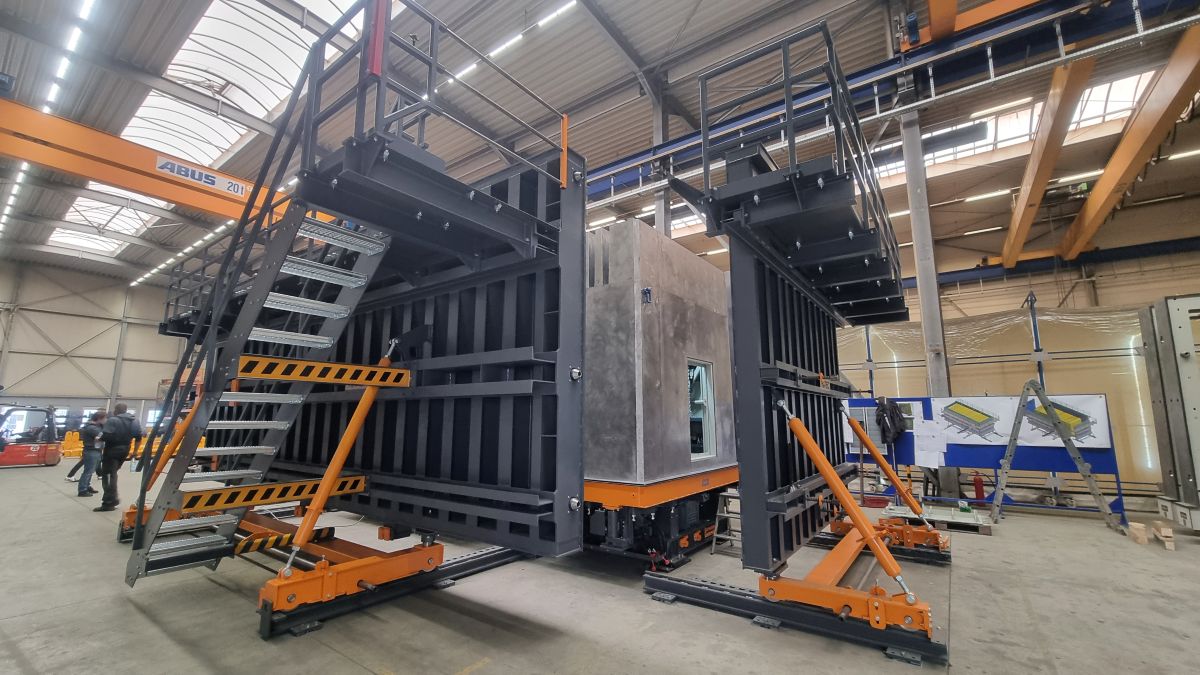
Demand for compact transformer substations continues to grow. The strongest driver for this is the expansion of power grids to meet the increasing demand for electric vehicle charging infrastructure and the power supply of data centres. As a result, manufacturers need to further ex-pand their production capacities while also being able to manufacture a growing range of different substation types economically. Issue 02.2025 of CPi featured a report on the installation of several adjustable moulds from Ratec for transformer substa-tions, cable basements and roofs at a new precast concrete plant in Central Europe. A further, particularly versatile mould has now been installed at the same plant. It is already the sixth transformer station mould supplied by Ratec to this customer, further expanding its production capabilities.
Taking flexibility to the next level
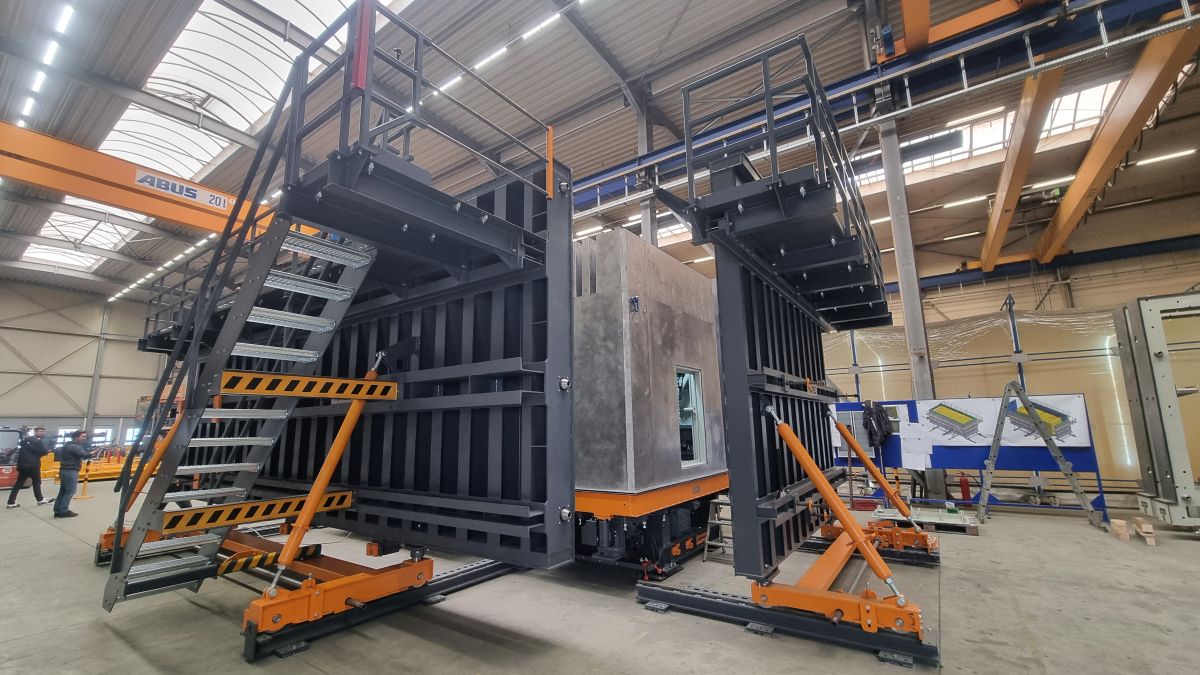
While the previously installed moulds were each adjustable in length and, in addition, either in width or height, the new mould combines all three adjustment options in a single sys-tem for the first time.
The mould can be:
- adjusted in length in 200 mm increments from 3 to 8 m,
- configured for two different widths of 2.50 m and 2.92 m, and
- set up for element heights of 2.60 m and 3.00 m.
In addition, a further grid has been incorporated for the inter-nal walls, which can also be configured flexibly. The required dividing walls are formed by slots in the movable and fixed endcores. If no internal walls are required, the correspond-ing slots are closed using closing wedges. This allows a very broad product range to be covered with a single mould. The previous moulds already enabled more than 1,000 different concrete bodies to be produced. With the simultaneous ad-justability in length, width and height, the number of possible variants is increased even further.
High flexibility requires intelligent mechanics
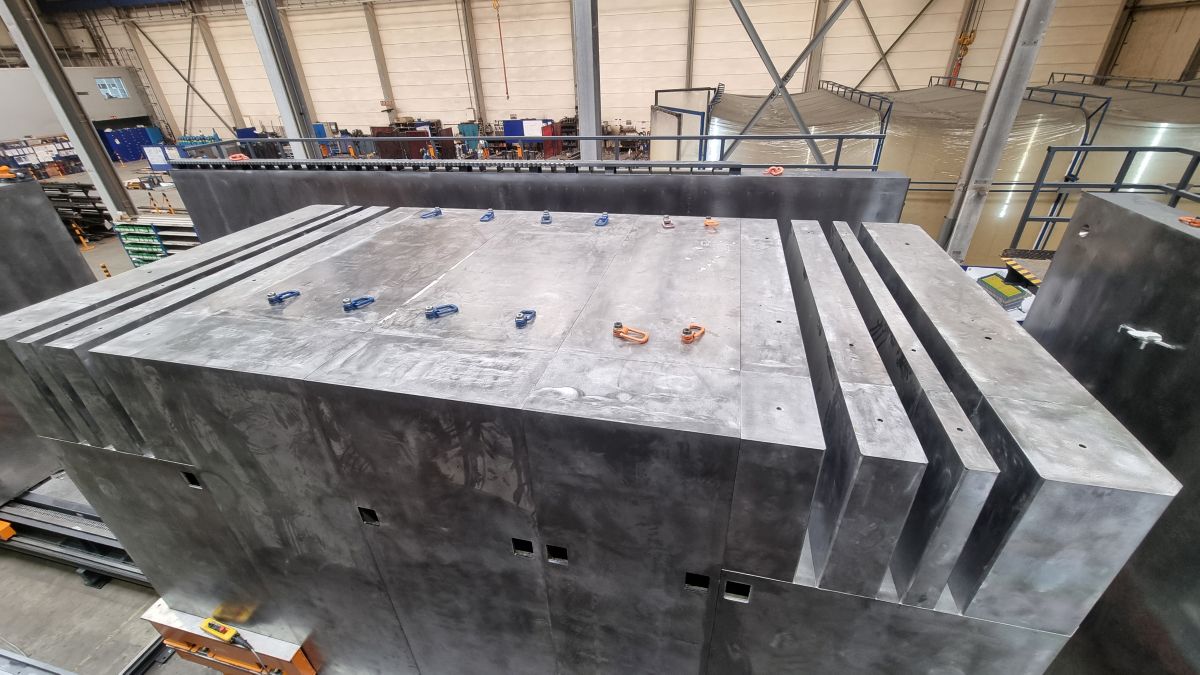
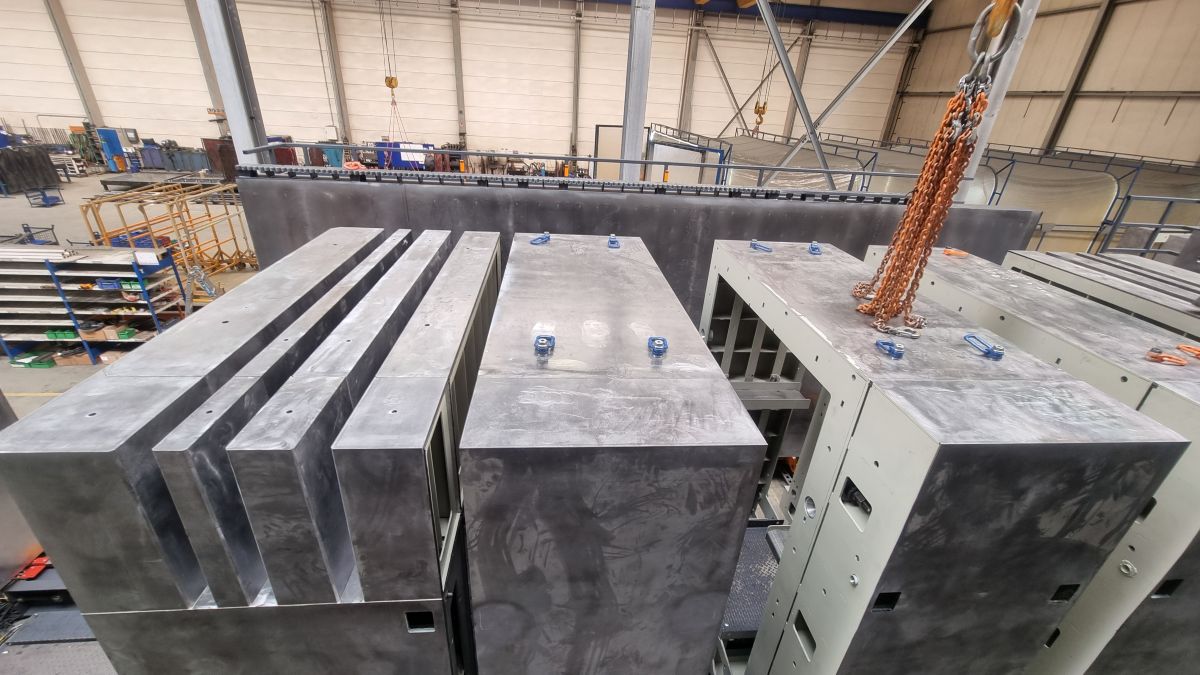
The core consists of various core segments that provide the required flexibility in length and width. It features one fixed end core and one movable end core. All core segments are interconnected: when the movable end core is moved, the core segments are automatically driven apart or together. The two possible element heights are adjusted via the bottom shutter. For this a set of steel formwork with the height of
400 mm can be magnetically mounted on the base formwork of each core segment to reduce the element height accord-ingly. All segments had to be designed and manufactured in such a way that, despite the high degree of flexibility, they guarantee consistently reproducible dimensional accuracy. The interaction between flexibility in length, width and height, together with the different core segments, presented particular challenges for both engineering and assembly. The objective was to achieve a high degree of flexibility without compromising ease of operation or process reliability. An-other feature of the new mould is its walk-in internal core. The entire core is locked from the inside using a chain hoist. A total of 24 high-frequency vibrators are installed on the base frame – twelve on each longitudinal side – ensuring uni-form concrete compaction even for large elements. The outer panels and the movable end core are operated via rack-and-pinion drives. For demoulding, the bottom shutter is raised hydraulically. This first releases the concrete element from the core in a controlled manner, after which it can be safely lifted out of the mould using the overhead crane.
Flexible recesses for different substation types
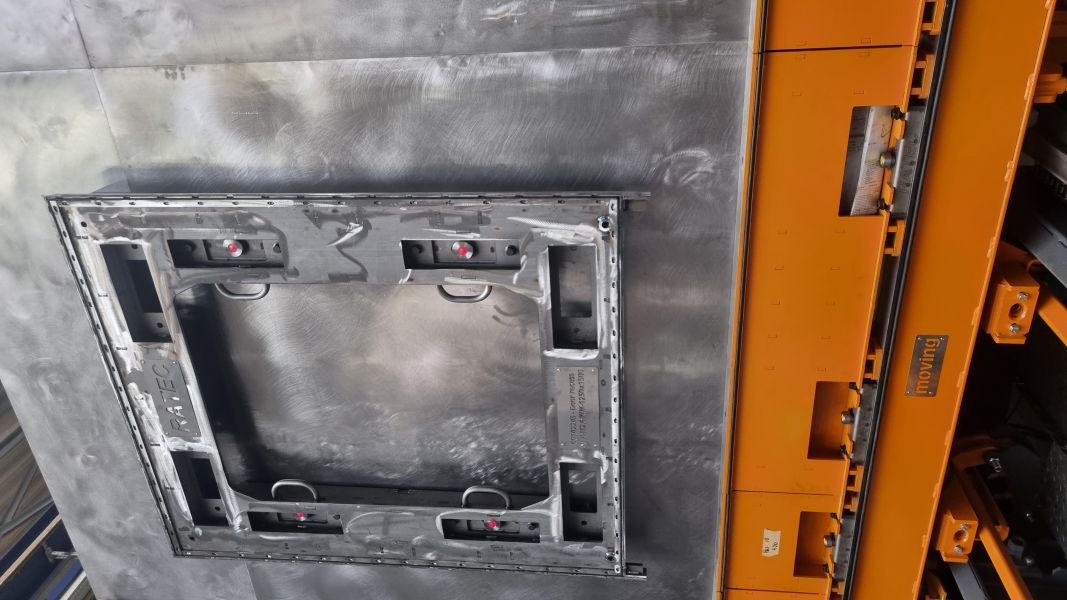
The mould also offers various options for openings. The door recess can either be mounted on the inner core or alterna-tively on the outer panel. The recess frames were initially developed in close cooperation with the door manufacturer, ensuring that the solution was tailored to the actual require-ments and conditions. A total of nine variants are available to the customer.
Engineering rather than a standard solution
The current project is a good example of Ratec’s approach to development. Rather than starting with an existing standard system, every mould is based on the customer's specific ele-ment catalogue. At an early stage of the project, the production programme, required variants, available space and planned production capacities are analysed. Based on this, an individually de-signed moulding solution is developed that can manufacture as many element types as possible with minimal set-up effort, without making the construction and operation unnecessarily complex. Experience gained from numerous projects involv-ing 3D moulds, magnetic formwork and plant engineering is incorporated into the development process. The objective is always to simplify production processes, make efficient use of available floor space and, at the same time, ensure a high degree of dimensional accuracy in the precast elements.
Continuous development
With the delivery of its sixth transformer substation mould, the customer is continuing the step-by-step expansion of its production capabilities. At the same time, the project demon-strates how moulding systems can be continuously devel-oped to meet growing requirements. The result is an even greater range of possible variants combined with economical production – another step towards flexible production solu-tions for the production of transformer substations.