
 EN
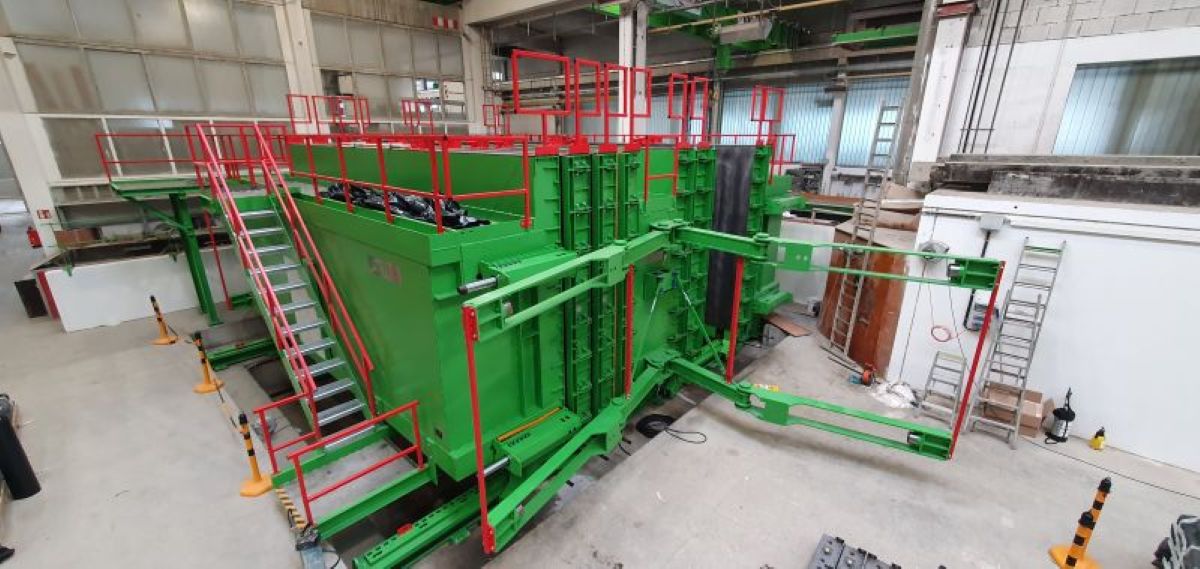
With a customised battery formwork from Ratec, Glass GmbH Bauunternehmung in Mindelheim has renewed its production capabilities. In close collaboration with Ratec, a solution was developed that meets very high standards of precision, stability, and operational comfort – optimally adapted to the local conditions.
The Glass Group, headquartered in Mindelheim, around 80 kilometres west of Munich, is one of the most significant construction companies in southern Germany. On its over 170,000 square metre site, the family-run business, now in its third generation, operates, among other things, its own precast concrete plant. With approximately 555 employees at this location, Glass covers almost all areas of construction from civil and bridge engineering to building construction and turnkey industrial and commercial projects.
Modernisation of the Production Line
The collaboration between Glass and Ratec emerged in the context of modernising the existing production line for large-format precast concrete elements. Glass already had an older battery formwork with a pit, which was, however, technically outdated. The aim of the project was to modernise production with a new, precise, and user-friendly battery formwork – while retaining the existing infrastructure. The existing scissor lift platform with end actuators had also become heavily worn after many years of intensive use. As part of the project, a new lift platform was procured to significantly improve both safety and ergonomics.
The requirements for the desired formwork were demanding: smooth surfaces on both sides, minimal dimensional toler-ances, suitability for self-compacting concrete, and precise integration into the existing structural conditions.
After intensive discussions and factory visits at Ratec in Hock-enheim, and examining another battery formwork from Ratec, the decision was ultimately made in favour of a customised solution from Hockenheim. Key factors were, in addition to the technical expertise of the development team, the detailed project support, geographical proximity, flexibility in adapt-ing to local conditions, and the cooperative partnership.
Key Technical Data
The installed solution is a battery formwork with 2 × 3 pock-ets, designed for elements with a net size of up to 8.00 m × 3.55 m and wall thicknesses from 10 to 25 cm. The elements are primarily used in industrial and commercial construction, where high dimensional accuracy and surface quality are required.
The battery formwork consists of a robust steel construction with the following main components:
- 4 partition walls, with 10 mm steel sheets on both sides, movable on rollers via a drive mechanism
- 1 fixed central tension wall, with 10 mm steel sheets on both sides
- 2 movable tension walls, manually driven via the drive mechanism
- Panels with a flatness tolerance of ±1.5 mm / 3 m
- Hydraulic clamping unit with 2 × 4 cylinders per side, au-tomatic pressure monitoring, and reclamping function
- Base frame with running rails and 12 carriages to guide the walls
The system is designed for filling with self-compacting concrete (SCC).
Concrete is poured from above, with each pocket able to be filled independently. Concrete pressure is absorbed via the outer tension walls against the central tension wall.
The new scissor lift platform with a 1,000 kg load capacity allows access between the panels. Two electromechanical 1-metre extensions at the end faces enhance safety and facilitate operation.
The use of magnetic formwork components allows rapid adjustment of wall thicknesses – a crucial factor for flexibility in production. The formwork system consists of modular side formwork, base formwork, and central supports with integrated SPB magnetic systems, which are clad with plywood on-site, along with additional components such as chamfer strips, extension angles, and top boxes.
Assembly and commissioning were carried out by Ratec assembly team in collaboration with customer’s factory staff. The existing pit was reused and adapted to the new formwork system. Following installation, commissioning and functional testing were performed, including a factory pre-acceptance of the lift platform.
Challenge Mastered: Precision Despite Limitations
During the project, several customer-specific requirements had to be fulfilled:
- Integration into the existing pit
The new battery formwork was integrated into the pit of the previous system, allowing the existing infrastructure to be reused and minimising conversion effort. - Stability and dimensional accuracy
Due to the high requirements for the flatness and di-mensional accuracy of the produced concrete elements, the formwork was designed to be particularly torsion-resistant. Panels are clad with 10 mm thick steel sheet, with a flatness tolerance of ±1.5 mm over 3 m, ensuring con-sistently precise production results. - Self-compacting concrete
The formwork is designed for top-down concrete pour-ing and meets the requirements for tightness and sta-bility during the processing of self-compacting concrete (SCC). - Hydraulic clamping
A hydraulic clamping unit with 2 × 4 cylinders per side ensures uniform pressure distribution and reliable clamping during concreting and curing. - Magnetic formwork system
The magnetic formwork components enable rapid adaptation to different element heights and geometries. - Continuously adjustable wall thickness
Variable top angles and top boxes allow wall thicknesses from 100 mm to 250 mm to be adjusted continuously without additional conversion time. - Ergonomic operation
Operation and access to the formwork are facilitated by integrated walkways and the new scissor lift platform, enhancing both safety and productivity. The formwork was precisely matched to the existing pit and, in combination with the new lift platform, constitutes a modern, ergonomic, and safe production unit.
In close cooperation between the customer and the technical team, a solution was developed that considered all safety requirements – such as railings, stair access, and statutory regulations.
Positive Overall Assessment
Franz-Rainer Göhrle, Head of the Precast Plant at Glass, gives a positive summary: “The collaboration with Ratec was extremely pleasant on all levels. As a customer, we always felt very comfortable and had the impression that all employees involved in the project carried out their work with genuine passion. We had a shared goal in mind, and it was pursued with dedication by both parties. From our side, great praise and thanks to all Ratec staff!”
Both the technical implementation and project organisation met the high expecta-tions. Timely delivery, high professional expertise, and open, respectful communi-cation characterised the collaboration.
“We are very grateful to Glass for giving us the opportunity to demonstrate our ca-pabilities,” says Jörg Reymann, Managing Director of Ratec GmbH. “Every solution we provide is developed in close consultation with the customer – we do not sell off-the-shelf standards. Our aim is to make our customers’ production processes better and more efficient. We take their requirements and wishes seriously and develop a solution that fits perfectly to each plant and its individual workflows. This is what makes such projects so special for us.”
The installation of the new battery formwork in Mindelheim demonstrates that the success of such projects lies primarily in open communication and careful coordina-tion between customer and manufacturer – with a solution that optimally supports operations on-site. Ratec once again proved its expertise in developing customised solutions. Customer satisfaction is always the top priority.